Almost every industrial flow is turbulent, and no practical simulation resolves all of it. The real decision is how much of the turbulence to compute directly and how much to hand to a model. That choice changes the cost by orders of magnitude and decides which questions the results can answer. This article sets out what RANS, LES and hybrid methods such as DES actually do, and how to choose between them.
What is resolved and what is modelled
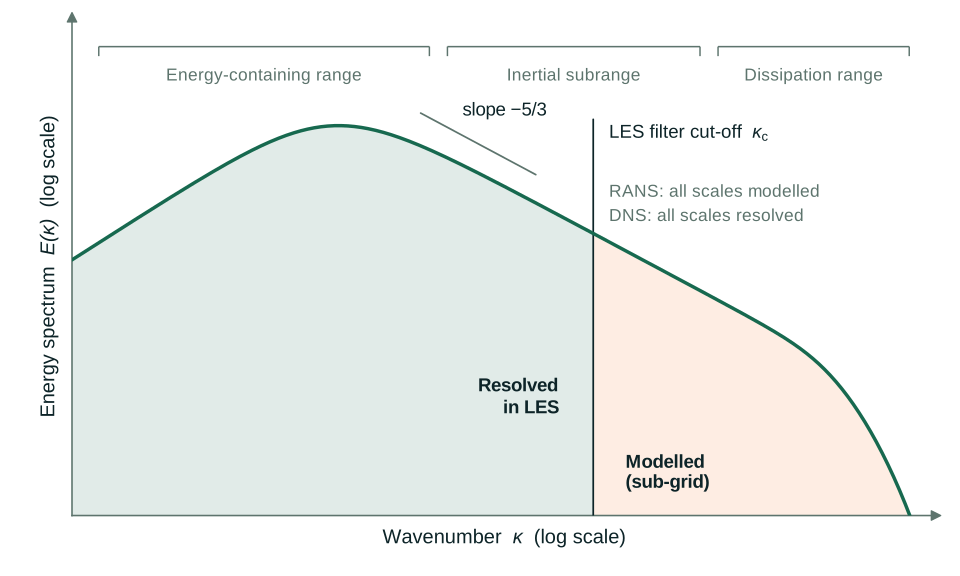
Turbulence spans a wide range of eddy sizes. Large eddies, set by the geometry, carry most of the kinetic energy. They break down through the inertial range into small eddies, where viscosity dissipates the energy as heat. The energy spectrum at the top of this article shows that cascade, and the three families of method differ in where they draw a line across it.
- RANS (Reynolds-averaged Navier–Stokes) solves for the mean flow only. Every turbulent scale is represented by a closure model for the Reynolds stresses.
- LES (large-eddy simulation) resolves the large, energy-carrying eddies in space and time and models only the scales smaller than the mesh, through a sub-grid model such as Smagorinsky or WALE.
- DNS (direct numerical simulation) resolves everything down to the Kolmogorov scale. Its cost grows roughly as Re3, so it is a research tool for low Reynolds numbers, not a design tool.
How the cost scales
RANS can be run steady and needs a mesh fine enough only for the gradients of the mean flow. LES is always three-dimensional and time-dependent. The time step has to follow the resolved eddies (a Courant number near one), and the run must continue long enough to collect converged statistics. As a rough guide, expect two or more orders of magnitude more compute than a steady RANS run of the same geometry.
Walls make it worse. Near a wall the energy-carrying eddies shrink with the viscous length scale, so the mesh for a wall-resolved LES grows almost as fast as Re2 (Chapman's classic estimate is Re1.8). Modelling the near-wall layer instead weakens that dependence considerably, which is why wall-modelled LES and hybrid RANS–LES methods exist.
Common RANS closures and where they struggle
- k-ε (standard and realizable): robust, economical and normally paired with wall functions. It is weak in adverse pressure gradients, where it predicts separation late or not at all, and it over-produces turbulence at stagnation points. The standard version also over-predicts the spreading rate of round jets.
- k-ω SST: blends k-ω near the wall with k-ε in the free stream and limits the shear stress in adverse pressure gradients. It is the usual first choice for aerodynamics, turbomachinery and wall heat transfer, provided the mesh resolves the viscous sublayer (see our note on y+ and near-wall meshing). It can still misjudge the size of separated regions.
- Spalart–Allmaras: a one-equation model built for attached aerodynamic boundary layers. It is cheap and well behaved, but less suited to jets, free shear layers and strongly separated flow.
All three share the Boussinesq assumption that turbulent stresses align with the mean strain rate. That fails where turbulence is strongly anisotropic: strong swirl, streamline curvature, impingement, and the secondary flows in the corners of non-circular ducts. Curvature corrections and Reynolds-stress models help, at some cost in robustness.
When scale-resolving simulation earns its cost
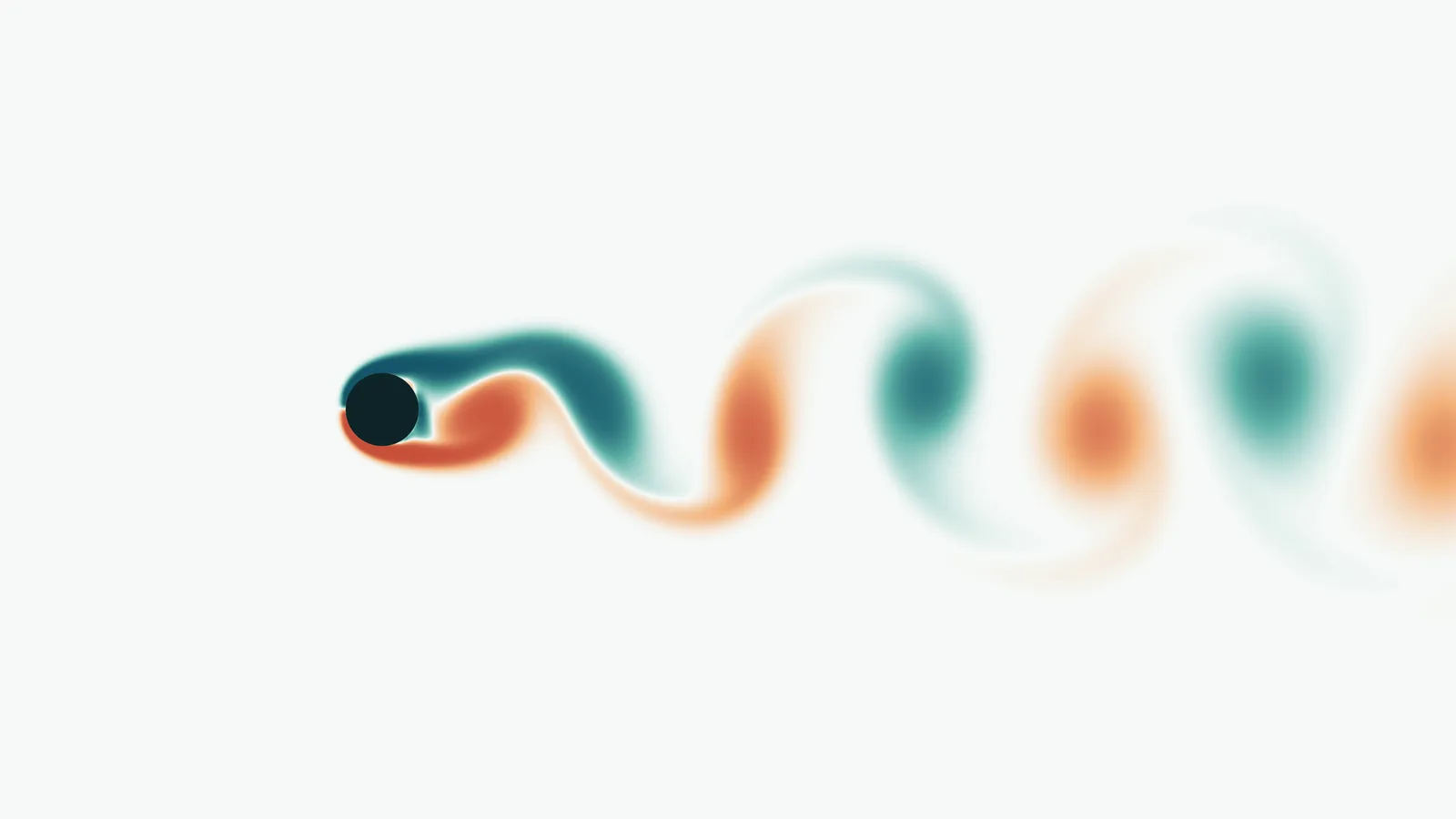
Use LES when the unsteady large eddies are themselves the answer: broadband aeroacoustic sources, fluctuating loads and flow-induced vibration, mixing and combustion, bluff-body wakes, or separation from smooth surfaces that RANS misplaces. For periodic shedding with a clear dominant frequency, such as the Kármán street behind a cylinder, unsteady RANS can often capture the shedding frequency at modest cost. It returns only the coherent motion, though, not the broadband turbulence that rides on it.
Hybrid methods: DES and its successors
Detached-eddy simulation (DES) uses a RANS model in attached boundary layers and switches to LES behaviour in separated regions. The switch depends on the local grid spacing relative to the wall distance, which made the original formulation sensitive to meshing. An ambiguous grid inside the boundary layer could trigger LES mode too early, deplete the modelled stress and cause grid-induced separation.
Delayed DES (DDES) shields the boundary layer from this, and IDDES adds a wall-modelled LES branch. Scale-adaptive simulation (SAS) is a related alternative. All hybrids have a grey area just downstream of the switch, where modelled turbulence has been removed but resolved turbulence has not yet developed. A fine, near-isotropic mesh in the separated shear layer shortens it.
A short decision guide
| What you need to know | Sensible starting point |
|---|---|
| Mean forces, pressure drop or heat transfer in mostly attached flow | Steady RANS, k-ω SST |
| Attached external aerodynamics | Steady RANS, Spalart–Allmaras or k-ω SST |
| Internal flow with strong swirl or secondary flow | RANS with curvature correction, or a Reynolds-stress model |
| Periodic shedding with one dominant frequency | Unsteady RANS as a first pass |
| Massive separation at high Reynolds number | DDES or IDDES |
| Broadband noise, fluctuating loads, mixing-controlled processes | LES, wall-modelled at high Reynolds number |
| Fundamental physics at low Reynolds number | DNS |
Treat the table as a starting point. The model should follow from the quantity you need, not from what looks most sophisticated.
A common rule of thumb is to resolve about 80 % of the turbulent kinetic energy. An LES run on a RANS-style mesh resolves far less and can be less accurate than the RANS it replaced.
Whichever model you choose, its error sits on top of the numerical error. Establish mesh convergence before attributing a discrepancy to the turbulence model.
How CFD Pro can help
CFD Pro supports clients from problem definition through to verified results and reporting, and that includes matching the turbulence approach to the decision the simulation has to support. If you are unsure whether your problem needs RANS, a hybrid method or LES, send us a project brief and we will discuss a suitable approach and what it would involve.